Defusion: How One ACT Technique Works With the Neurodivergent Nervous System, Instead of Against It
If you've ever tried to argue your way out of a thought and found yourself more tangled in it an hour later, you've bumped into one of the limits of traditional cognitive work. There's a different approach that sidesteps that trap entirely, and it tends to land especially well for ADHD and autistic brains. It's called defusion, and it comes from Acceptance and Commitment Therapy.
What Is ACT, and Why Does It Tend to Work Well for Neurodivergent Brains?
Acceptance and Commitment Therapy (ACT, said as one word, "act") is a third-wave behavioral therapy built on a simple but uncomfortable premise: trying to fight, remove, or control your own thoughts and feelings usually backfires, and often makes them louder. Instead of targeting the content of your thoughts, ACT targets your relationship to them, working toward what it calls psychological flexibility, the ability to stay present with a difficult inner experience while still moving toward what actually matters to you. It does this through six interconnected skills, often called the hexaflex: contacting the present moment, acceptance, defusion, self-as-context, values, and committed action.
Two things about that approach tend to make it fit neurodivergent brains particularly well. First, ACT doesn't treat your thoughts as distorted and in need of correction. For a lot of ADHD and autistic people, a therapy that opens by asking you to find the flaws in your own thinking lands as one more thing you're doing wrong, on top of a lifetime of being told your thinking is wrong. ACT starts somewhere else: your thoughts are just what your mind does, and that's not the problem. Second, ACT is strengths-based and values-driven rather than symptom-focused, which matters for clients who've spent years being defined by a deficit list. Emerging research backs this up directly: systematic reviews have found ACT reduces psychological distress and improves adaptive functioning in autistic adults, and randomized trials have shown it improves psychological flexibility in parents of autistic children as well. A course built specifically around ACT for autistic clients describes the approach as strengths-based, values-inspired, and centered on safety, particularly when the work touches something as vulnerable as self-advocacy or unmasking.
Cognitive Fusion: The Extremely Common Trap of Believing Your Thoughts Are Facts
Before defusion makes sense, it helps to understand what it's undoing: cognitive fusion. Fusion is what happens when you respond to a thought about a thing as though it were the thing itself, rather than as one mental event passing through, among many. The thought "I always ruin everything" doesn't feel like a thought when you're fused with it. It feels like a fact you're reading off reality.
Here's the part worth knowing: fusion isn't a malfunction or a diagnosis. According to relational frame theory, the research base underneath ACT, fusion is the default mode of human cognition. Most people, most of the time, treat their thoughts as reliable narrators. That's actually useful most of the time, since it's what lets language guide behavior at all. The problem shows up specifically when fusion happens with thoughts that are harsh, rigid, or untrue, and behavior starts following them anyway.
For neurodivergent brains, fusion often has more surface area to grab onto. Autistic cognition frequently includes what's called monotropic thinking, a tendency to hyperfocus narrowly and deeply on one thing at a time, including one thought or worry, which makes it harder to shift attention away once a thought has taken hold. Autistic adults also report more repetitive, looping cognitive experiences than non-autistic peers, and rejection sensitivity common in both ADHD and autism can make a single painful thought feel less like an opinion and more like a verdict. None of this means neurodivergent people are worse at managing their thoughts. It means the thoughts land harder and stick longer, which is exactly the situation defusion is built for.
What Defusion Actually Is, and Why It Fits So Well Here
Defusion is the ACT skill of creating distance between yourself and a thought, so the thought stops functioning like an order you have to obey or a fact you have to accept. Crucially, defusion does not try to change what the thought says. It changes what the thought does to your behavior. A thought like "I'm going to embarrass myself" doesn't get argued down to "actually, I probably won't." It gets relocated: from something you are, to something you're noticing your mind produce.
This is a meaningfully different move than most people expect from therapy, and it's part of why it tends to work well for neurodivergent clients specifically. It doesn't require you to win an internal debate, which matters if your thinking style is more literal or rule-based and a forced-positive replacement thought doesn't feel true enough to stick. It doesn't ask you to stop a thought from recurring, which matters if monotropic attention makes stopping genuinely difficult. It just asks you to notice the thought as a thought. That's a smaller, more concrete ask, and concrete tends to be where a lot of neurodivergent brains do their best work.
There's real evidence behind this, including research specifically on autistic adults. A controlled study on cognitive defusion for reducing distressing thoughts in autistic adults found the technique measurably reduced how much participants believed and were bothered by their distressing thoughts. More broadly, a 2026 meta-analysis of defusion research found large effects on both how believable a thought feels and how much discomfort it causes, with one of the simplest techniques, repeating a word until it loses its meaning, showing some of the strongest results of all.
Defusion Techniques by Type
Defusion isn't one exercise, it's a category of moves, and different ones land for different people. Here's a set organized by what sense or skill they lean on.
Linguistic Defusion — Changing the language around a thought to expose it as a thought.
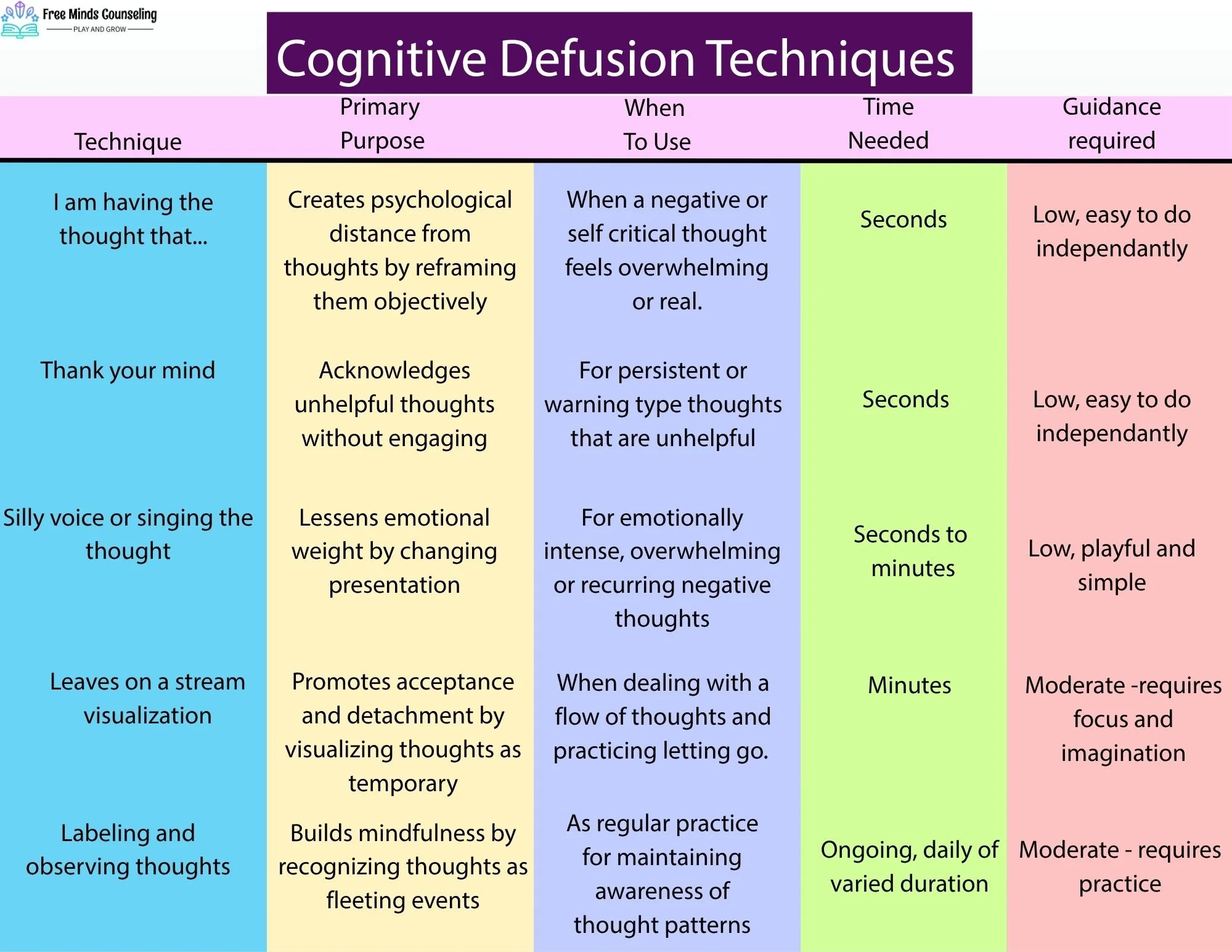
"I'm having the thought that...": Insert this phrase before a difficult thought. "I'm a failure" becomes "I'm having the thought that I'm a failure." Same content, noticeably different weight.
Naming the story: Give a recurring thought pattern a title, like "the not-good-enough story," and notice when it shows up again. "Oh, there's the not-good-enough story" creates distance the raw thought doesn't.
Analytical Defusion — Evaluating a thought by its usefulness rather than its truth.
The workability question: Instead of asking "is this thought true?" ask "is believing this thought helping me move toward what matters to me right now?" ACT treats workability, not accuracy, as the relevant test.
Function-checking: Ask what the thought is trying to do for you (often protect you from disappointment or embarrassment) and whether that protection is actually worth its cost right now.
Concrete Defusion — Giving an abstract thought a physical form.
Physicalizing: Ask what shape, size, color, or texture the thought would have if it were an object. A racing anxious thought might be small, hot, and spiky; naming that shifts your relationship to it.
The view from above: Picture the situation from further and further away, zooming out until it's the size of a map, then a country, then the globe, to shrink its apparent scale.
Tactile Defusion — Using physical movement or touch to mark the shift.
Hands in front of your face: Hold your hands over your eyes, notice how close and total that feels, then slowly lower them. The thought is like your hands: close up, it's your whole world; at a small distance, it's just one more thing you can see past.
Write and release: Write the thought on a piece of paper, physically hold it, then set it down, fold it, or place it aside, pairing the mental shift with a physical one.
Auditory Defusion — Changing how a thought sounds.
Silly voice: Say the thought out loud in a cartoon voice, an announcer voice, or any voice that isn't your own inner critic's. The content doesn't change; how seriously it can be taken does.
Word repetition: Pick the single most charged word in the thought and repeat it aloud for thirty to sixty seconds. This uses a real effect called semantic satiation, where a word said enough times stops sounding like meaning and starts sounding like sound.
Playful Defusion — Using humor or absurdity to loosen a thought's grip.
Sing it: Set the thought to the tune of "Happy Birthday" or another familiar song. It's hard for a thought to keep its authority set to a nursery rhyme.
Thank your mind: When a familiar unhelpful thought shows up, say, out loud or internally, "thanks, mind" and move on, treating the thought as your mind doing its overprotective job rather than delivering breaking news.
Defusion vs. Cognitive Restructuring: What's the Difference?
Cognitive restructuring, the core tool of traditional Cognitive Behavioral Therapy (CBT), works on the content of a thought. You identify a distorted thought, examine the evidence for and against it, and replace it with something more accurate. "I always mess this up" becomes "I made a mistake this time, and I've handled plenty of things well before." That process helps a lot of people, and it isn't in competition with ACT so much as it's a different tool for a different job.
Defusion doesn't try to change what the thought says. It changes how much authority the thought has over your behavior, whether or not you end up agreeing with it. That distinction matters more for some neurodivergent brains than it might sound at first. Restructuring depends on being persuaded by a new, more balanced thought, and persuasion is a harder sell for a literal or rule-bound thinking style; a replacement thought that doesn't feel fully true can just sit there unconvincing, or worse, become one more thing to argue with. Restructuring also asks you to examine a thought closely and build a case against it, which for a monotropic or ruminating mind can accidentally feed more attention to exactly the thought you were trying to get distance from. Defusion doesn't require winning that argument. It just asks you to notice you're having it.
In practice, a lot of clinicians use both, choosing cognitive restructuring when a thought is inaccurate and worth correcting, and defusion when a thought is simply too sticky, too fast, or too emotionally loaded to argue with productively in the moment.
You don't need to win a debate with your own mind. You need to notice you're in one. That single shift, from believing every thought to simply watching them go by, tends to change more than years of arguing ever did.
Sources for Further Reading
Defusion: A Behavior-Analytic Strategy for Addressing Private Events — PMC
A Short Guide to Acceptance and Commitment Therapy — Contextual Science
ACT vs CBT: A Helpful Guide to Choosing the Right Therapy for You — Emora Health
Cognitive Defusion: 7 Ways to Unhook From Thoughts — Wellness AI
14+ ACT Interventions & Helpful Therapy Techniques — PositivePsychology.com
Cognitive Defusion Techniques: 7 Practical ACT Exercises for Negative Thoughts — Total Self Health
Autism and Rumination: Understanding the Link — Autism Parenting Magazine
How Does Autism Affect Thinking? From Overthinking to Deep Focus — Autism Parenting Magazine